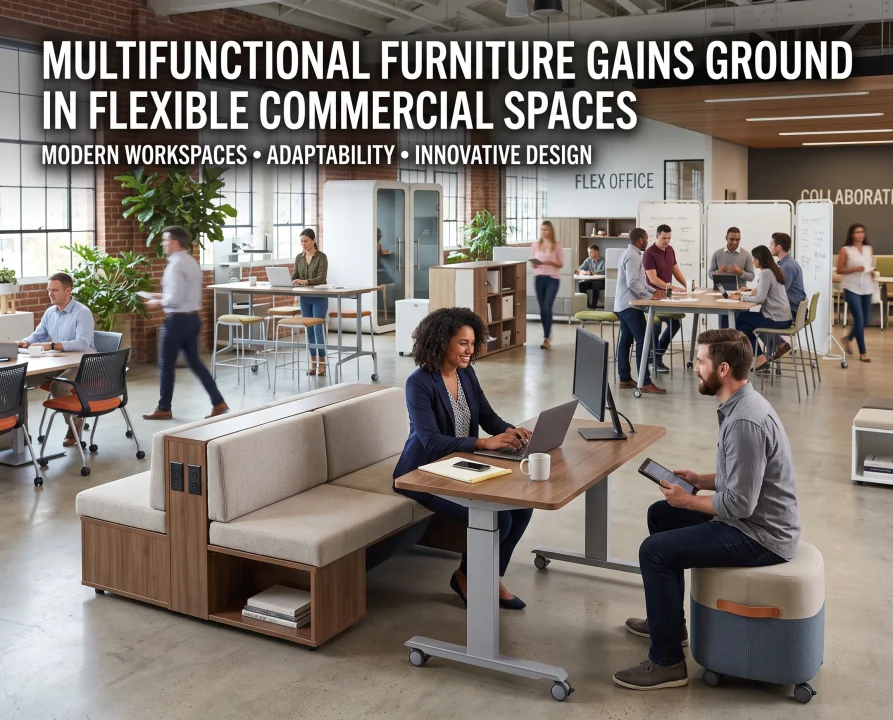
Commercial interiors are becoming increasingly adaptable as businesses rethink how their spaces are used throughout the day. Offices, hotels, restaurants, educational facilities, and shared environments are looking for furniture that can support multiple activities without requiring permanent changes to the architecture.
This is increasing demand for multifunctional and modular furniture designed to respond quickly to changing requirements.
One Space, Multiple Functions
Modern commercial environments often need to accommodate different activities within the same area.
A meeting space may become a collaborative workspace, while a hotel lounge can transform into an event area. Furniture that can be moved, reconfigured, or combined allows businesses to make better use of available floor space.
Modular Systems Provide Flexibility
Modular furniture systems are particularly valuable in environments where layouts change frequently.
Modular sofas, tables, partitions, storage units, and seating systems can be rearranged according to specific requirements.
This approach allows companies to adapt interiors without investing in major architectural modifications.
Supporting Hybrid Workplaces
The growth of flexible working has increased demand for adaptable office furniture.
Employees may require individual workstations at one moment and collaborative spaces at another. Furniture systems that support both functions can help organizations create more efficient workplace environments.
Hospitality Spaces Become More Versatile
Hotels and restaurants are also exploring multifunctional furniture.
A restaurant may need flexible seating arrangements for everyday dining, private events, and larger gatherings. Hotels may require furniture that allows lounges and meeting areas to accommodate different types of guests and activities.
Furniture as a Space-Planning Tool
Multifunctional furniture can also help define zones within large open interiors.
Shelving systems, acoustic partitions, modular seating, and mobile screens can separate areas without creating permanent walls.
This gives designers greater freedom to create flexible spatial arrangements.
Durability Remains Critical
Commercial furniture must be designed for intensive use.
While flexibility is important, products must also withstand frequent movement, cleaning, reconfiguration, and everyday wear.
Manufacturers therefore need to balance lightweight construction and mobility with structural durability.
Sustainability Through Longer Use
Adaptable furniture can contribute to more sustainable interiors by extending the useful life of products.
Instead of replacing furniture whenever a company changes its layout, modular systems can be reconfigured to meet new requirements.
This reduces the need for complete replacement and can lower material consumption over time.
The Future of Commercial Furniture
Commercial environments are expected to become even more flexible as businesses continue adapting to changing work patterns and customer expectations.
Furniture manufacturers will likely focus on modular products that combine mobility, durability, technology, acoustic performance, and sustainable materials.
Multifunctional furniture is becoming an important component of modern commercial interiors. By allowing spaces to change according to different activities, these products provide businesses with greater flexibility while making better use of available floor area.
As commercial environments continue to evolve, adaptable furniture will play an increasingly important role in creating spaces that can respond to changing needs without requiring constant renovation.