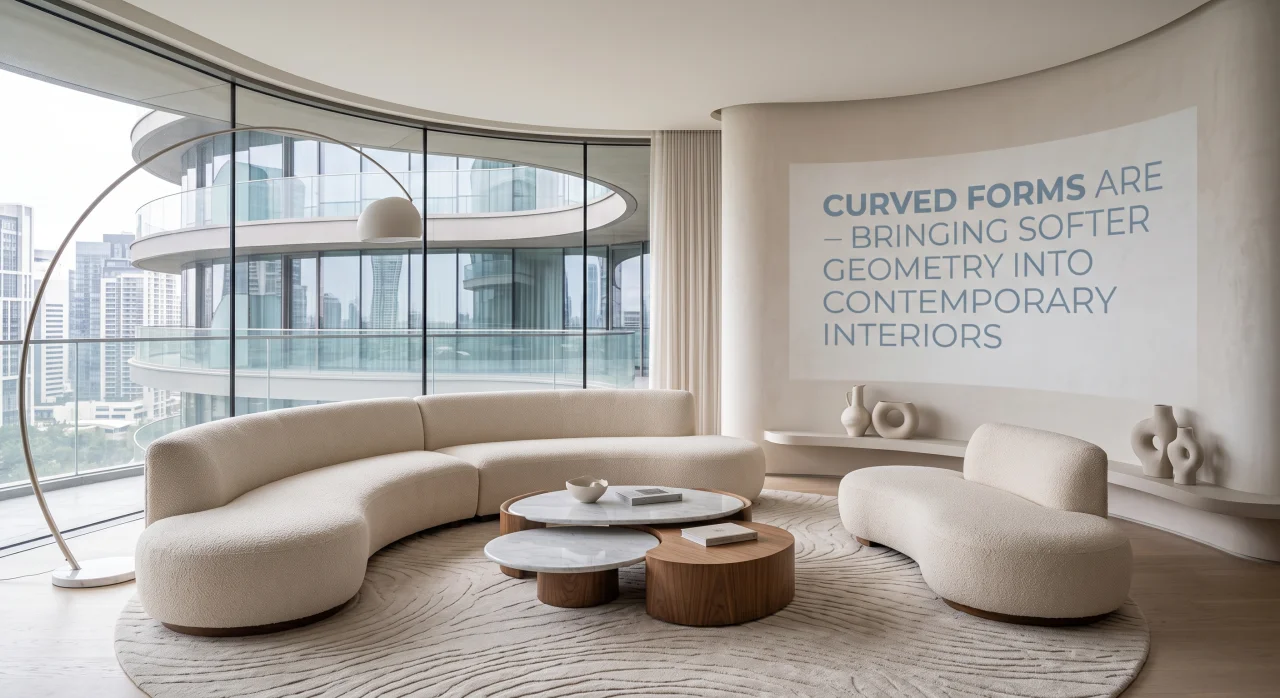
Straight lines and sharp geometric forms have dominated many contemporary interiors for years. However, a growing interest in softer shapes is changing the visual language of residential, hospitality, and commercial spaces.
Curved sofas, rounded tables, arched openings, circular lighting, and organically shaped furniture are increasingly being incorporated into modern interiors. These forms can create a softer atmosphere while introducing greater visual movement into architectural environments.
Curves Create Visual Flow
Curved forms can guide movement through an interior in a different way from rigid geometric elements.
A rounded sofa can encourage conversation, while a curved partition can create separation without creating a visually heavy barrier. Circular tables can also promote more inclusive social arrangements by removing the strong hierarchy associated with rectangular layouts.
Curved Furniture Becomes a Focal Point
Furniture with rounded silhouettes can act as a visual focal point within relatively simple interiors.
A curved armchair, sculptural sofa, or organically shaped coffee table can introduce character without requiring excessive decoration.
This makes curved furniture particularly suitable for minimalist interiors where individual pieces need to make a stronger visual contribution.
Hospitality Design Embraces Softer Shapes
Hotels, restaurants, and cafés are increasingly experimenting with curved furniture and architectural elements.
Rounded seating can make lounges and reception areas feel more welcoming, while curved counters and partitions can create a more fluid relationship between different zones.
For hospitality brands, these shapes can also contribute to a distinctive visual identity.
Materials Influence the Effect
The appearance of a curved form depends heavily on its material.
Wood can create a warm and natural interpretation, while upholstered furniture can emphasize softness and comfort. Metal and glass can produce a more contemporary expression.
Combining several materials can create contrast while maintaining the overall curved geometry.
Curves and Space Planning
Curved furniture requires careful planning.
Unlike rectangular pieces that can easily align with walls, rounded products often require more surrounding space. Designers therefore need to consider circulation, clearances, and relationships between furniture pieces.
When planned correctly, curved elements can improve the flow of a room rather than reduce its efficiency.
Technology Makes Complex Forms Easier to Produce
Advances in digital modeling and manufacturing are expanding the possibilities for curved furniture.
Computer-aided design, CNC production, 3D printing, and advanced molding technologies allow manufacturers to produce complex shapes with greater precision.
These technologies are helping designers experiment with forms that would previously have been difficult or expensive to manufacture.
The Future of Soft Geometry
Curved design is likely to remain relevant as designers continue exploring interiors that feel more comfortable, organic, and human-centered.
The trend does not necessarily mean that straight lines will disappear. Instead, contemporary interiors are increasingly combining rigid architectural elements with softer furniture and decorative forms.
Curved furniture and architecture are bringing a new sense of softness to contemporary interiors. Through carefully considered shapes, materials, and spatial arrangements, designers can create environments that feel visually dynamic while remaining functional.
The growing popularity of soft geometry demonstrates how furniture can influence not only the appearance of an interior but also the way people experience and interact with it.