
How CNC Technology Is Revolutionizing Modern Furniture Manufacturing
Discover how CNC technology is transforming furniture manufacturing through precision, efficiency, customization, and sustainable production.
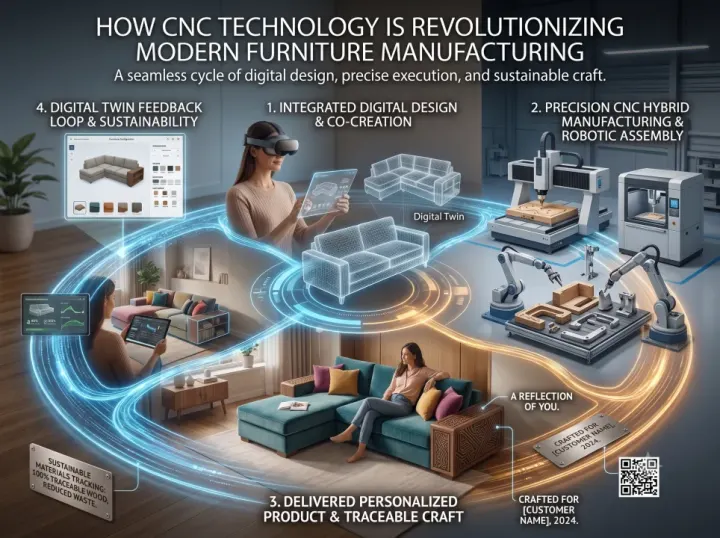
The furniture industry has always balanced craftsmanship with innovation. While skilled artisans continue to play an essential role, advanced manufacturing technologies are redefining how furniture is designed and produced. Among these innovations, Computer Numerical Control (CNC) technology has become one of the most significant developments in modern furniture manufacturing.
According to FurniPress, CNC machining enables manufacturers to achieve exceptional precision, improve production efficiency, and expand design possibilities while reducing material waste.
What Is CNC Technology?
CNC technology uses computer-controlled machines to cut, carve, drill, and shape materials with remarkable accuracy. Unlike manual production methods, CNC machines follow digital design files, ensuring consistent quality throughout the manufacturing process.
Whether producing a single prototype or thousands of identical components, CNC systems deliver reliable results with minimal variation.
Greater Precision in Every Component
Accuracy is one of CNC machining's greatest advantages.
Furniture components such as cabinet doors, shelving systems, table legs, and decorative panels can be manufactured with millimeter-level precision. This consistency simplifies assembly, improves product quality, and reduces production errors.
The result is furniture that fits together perfectly while maintaining high structural integrity.
Expanding Design Possibilities
Modern furniture increasingly features complex geometries that would be difficult or impossible to produce manually.
CNC technology allows designers to create:
- Intricate carved surfaces
- Curved wooden panels
- Decorative perforated patterns
- Customized joinery
- Unique architectural furniture details
This creative freedom enables manufacturers to develop distinctive collections while maintaining efficient production.
Faster Production with Consistent Quality
Automation significantly improves manufacturing speed.
Once a digital design has been finalized, CNC machines can produce components continuously with consistent quality. This reduces lead times while allowing manufacturers to respond quickly to changing market demands.
Consistency also minimizes costly production mistakes and material waste.
Supporting Custom Furniture Production
Consumer demand for personalized furniture continues to grow.
CNC technology makes customization practical by allowing manufacturers to modify dimensions, patterns, or design details directly within digital files. This flexibility enables efficient made-to-order production without requiring entirely new manufacturing processes.
Sustainability Through Precision
Material efficiency is becoming increasingly important within the furniture industry.
Because CNC machines optimize cutting paths, manufacturers can maximize material usage while reducing offcuts and unnecessary waste. Many factories also use software that arranges components strategically on raw material sheets to improve yield.
This contributes to more sustainable production and lower manufacturing costs.
Integration with Digital Design Software
One of CNC technology's greatest strengths is its compatibility with modern design software.
Architects and furniture designers can transfer CAD drawings directly to CNC equipment, creating a seamless workflow from concept to production. This digital integration reduces communication errors while accelerating product development.
The Future of CNC in Furniture Manufacturing
CNC technology continues to evolve alongside artificial intelligence, robotics, and smart factories.
Future manufacturing facilities are expected to combine CNC machining with automated material handling, real-time quality monitoring, and AI-driven production optimization. These innovations will further improve efficiency while enabling even greater levels of customization.
CNC technology has transformed furniture manufacturing by combining precision, flexibility, and efficiency. From intricate custom designs to large-scale production, computer-controlled machining is helping manufacturers meet the growing demand for high-quality, personalized furniture.
As digital manufacturing continues to advance, FurniPress remains committed to exploring the technologies and innovations that are shaping the future of furniture design and production.
Comments
0 comments
No published comments yet. Be the first to join the conversation.