
Flexible Workstations Support the New Generation of Office Design
Flexible workstations are transforming office design through modular layouts, adjustable desks, collaborative areas, and furniture designed for changing work patterns.
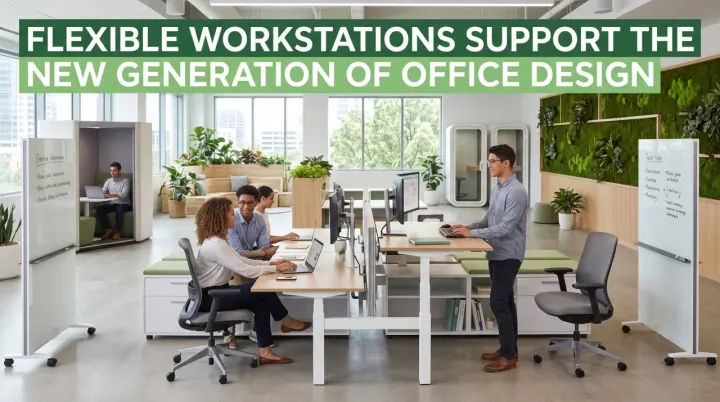
The modern workplace is becoming less dependent on fixed desks and permanent seating arrangements. As companies adopt hybrid working, collaborative environments, and activity-based workplace models, office furniture is being redesigned to provide greater flexibility.
Flexible workstations allow businesses to adapt their office layouts according to changing teams, activities, and working patterns.
Fixed Desks Give Way to Adaptable Systems
Traditional offices often assigned one permanent desk to each employee.
Modern workplace strategies may use shared workstations, hot-desking systems, and flexible seating instead. This allows companies to make more efficient use of available space.
Furniture manufacturers are responding with desks and workstation systems that can be moved or reconfigured.
Height-Adjustable Desks Support Different Working Positions
Adjustable desks are becoming increasingly common in contemporary workplaces.
Employees can modify desk height according to their preferred working position, while some systems allow users to alternate between sitting and standing.
This flexibility has become an important consideration in ergonomic workplace design.
Collaboration Requires Different Furniture
Not every task requires an individual workstation.
Teams may need spaces for meetings, brainstorming, presentations, or informal discussions. Modular tables, mobile whiteboards, flexible seating, and movable partitions can help offices transition between these activities.
Technology Integration
Flexible workstations must accommodate modern technology.
Cable management, power access, monitor systems, docking stations, and charging points are becoming important parts of workstation design.
Integrating these features into furniture helps maintain organized and efficient work environments.
Furniture Supports Hybrid Work
Hybrid working has changed the relationship between employees and office space.
Offices increasingly need to support employees who may not be present every day. Flexible workstations can help companies adjust their space requirements without committing to large numbers of permanent desks.
Adaptability Can Reduce Renovation Costs
Furniture that can be rearranged provides businesses with an alternative to frequent architectural changes.
When teams move or organizational structures change, furniture can often be reconfigured rather than replaced.
This can make office environments more adaptable over the long term.
Sustainable Workplace Furniture
Flexible furniture can also support sustainability.
Products that can be reconfigured, repaired, expanded, or reused may remain functional for longer periods. Modular components can potentially be replaced individually instead of requiring complete furniture replacement.
Looking Ahead
Office furniture will continue to evolve as businesses experiment with new workplace models.
The next generation of workstation systems is likely to combine flexibility, ergonomics, technology integration, acoustic performance, and sustainability.
Flexible workstations are becoming an essential component of modern office design. They allow businesses to adapt their environments to changing work patterns while supporting individual focus, collaboration, and technology use.
As workplaces continue to evolve, adaptable furniture will remain an important tool for creating efficient and future-ready offices.
Comments
0 comments
No published comments yet. Be the first to join the conversation.