
Flat-Pack Furniture Design Focuses on Efficient Transport and Assembly
Flat-pack furniture is evolving through improved packaging, efficient transportation, simplified assembly, and design strategies that support modern furniture distribution.
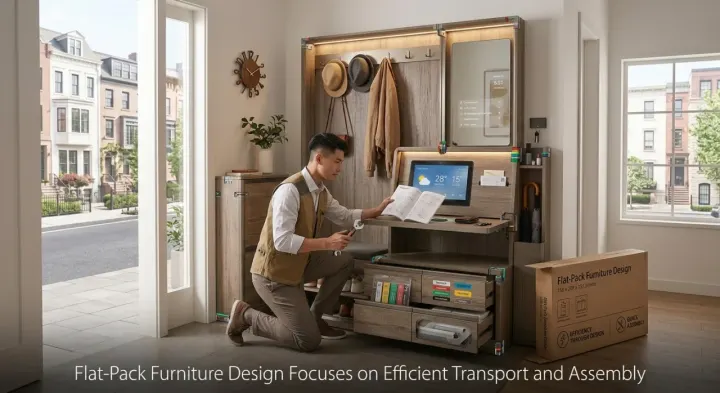
Flat-pack furniture has become an established part of the furniture market, particularly for products sold through large retailers and online platforms. By delivering furniture in disassembled components, manufacturers can reduce the space required for transportation and storage.
However, successful flat-pack design involves much more than placing furniture parts inside a compact box. Product dimensions, connection systems, packaging materials, assembly instructions, and distribution requirements all influence the overall experience.
Manufacturers are increasingly examining these elements together to create products that are easier to transport, assemble, and maintain.
Packaging Influences Product Design
Traditional furniture often requires substantial space during transportation because products are shipped fully assembled.
Flat-pack systems allow individual components to be arranged more efficiently inside packaging. This can make it possible to transport more units within a given shipment, depending on the product and packaging configuration.
Designers must consider packaging requirements early in the product development process. Panel dimensions, component shapes, and connection methods can all influence how efficiently a product can be packed.
Connection Systems Need to Be Reliable
Flat-pack furniture depends on connections that allow components to be assembled securely.
Cam locks, bolts, dowels, brackets, and other fastening systems are widely used across different furniture categories. The appropriate solution depends on the material, expected loads, product design, and whether disassembly is likely.
Reliable connections are essential because poorly designed joints can affect stability and make repeated assembly more difficult.
Assembly Experience Matters
The assembly process can strongly influence how customers perceive flat-pack furniture.
Clear instructions, accurately labeled components, accessible fastening points, and logically ordered steps can make assembly easier to understand.
Digital instructions and assembly videos can supplement printed manuals, but they should not introduce unnecessary complexity.
Manufacturers can also use product testing to identify steps that are confusing or require tools that customers may not have readily available.
Packaging Protection and Material Efficiency
Packaging must protect furniture components during handling, storage, and transportation.
Corners, edges, glass elements, and finished surfaces may require specific protection. At the same time, excessive packaging can increase material consumption and shipping volume.
The objective is to find a balance between adequate protection and efficient material use.
Recyclable packaging, optimized cardboard structures, and reduced reliance on unnecessary plastic components can support more responsible packaging strategies when suitable for the product.
Online Retail Increases the Importance of Logistics
E-commerce has made transportation and delivery central considerations in furniture product development.
Products may pass through several handling stages before reaching the customer. Packaging therefore needs to account for the realities of distribution networks rather than only ideal warehouse conditions.
Compact packaging can also make certain products easier to store and deliver, although the final benefits depend on dimensions, weight, handling requirements, and transportation methods.
Designing for Repair and Disassembly
Flat-pack construction can offer advantages beyond initial delivery.
Products designed with accessible fasteners may be easier to disassemble for moving, repair, or replacement of individual components. Standardized parts can also simplify maintenance.
These characteristics can contribute to longer product lifespans when replacement components remain available.
The Future of Flat-Pack Furniture
Manufacturers are likely to continue improving packaging optimization, fastening systems, assembly communication, and digital product documentation.
The next stage of development may place greater emphasis on products that are efficient to transport while remaining straightforward to assemble, repair, and disassemble.
Flat-pack furniture connects product design with packaging, logistics, assembly, and long-term maintenance. Its success depends on creating products that are not only compact to transport but also reliable and practical to use.
By considering these requirements from the earliest design stages, manufacturers can improve the customer experience while exploring opportunities for more efficient distribution and material use.
Comments
0 comments
No published comments yet. Be the first to join the conversation.