
Digital Product Visualization Changes How Customers Shop for Furniture
Digital product visualization is changing furniture retail through interactive catalogs, realistic product previews, online customization, and improved shopping experiences.
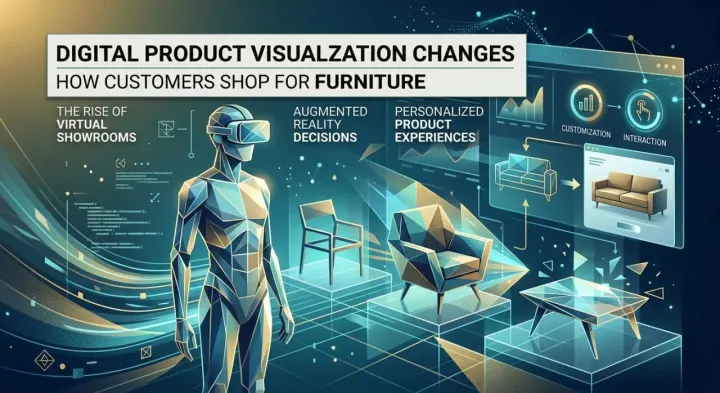
Buying furniture online can involve uncertainty. Customers need to understand a product's dimensions, materials, colors, and proportions before deciding whether it will work in their homes.
Digital product visualization is helping retailers address these challenges through realistic product images, interactive models, room previews, and online customization tools.
These technologies are changing how furniture is presented and how customers evaluate products before making purchasing decisions.
Product Images Become More Informative
Traditional product photography usually presents furniture from a limited number of angles.
Digital visualization can generate additional viewpoints and show different configurations, colors, and finishes. Customers may be able to examine a product more closely without relying exclusively on a single photograph.
Accurate product information remains essential. Images should represent the available product and should not create misleading expectations about materials, dimensions, or finishes.
Interactive Configuration Supports Personalization
Many furniture products are available in multiple configurations.
Sofas may have different upholstery options, tables may be offered in several sizes, and storage systems may include alternative layouts. Interactive product configurators allow customers to explore these variations before purchasing.
For retailers, this can make complex product ranges easier to present without photographing every possible combination separately.
Visualizing Furniture in a Room
Room visualization tools can help customers understand how furniture might fit within an existing interior.
Some applications allow users to place digital furniture models within photographs or augmented reality environments. This can provide a better sense of scale and spatial relationships than product images alone.
However, customers should still check exact measurements, circulation space, door clearances, and delivery access before ordering.
Digital Tools Support Physical Showrooms
Online visualization does not eliminate the value of physical furniture stores.
Customers may use digital catalogs to identify products before visiting a showroom to evaluate comfort, texture, and construction in person.
Retailers can connect these experiences through digital product information, showroom displays, and consistent product specifications.
Improving Product Information
Visualization works best when supported by accurate technical details.
Retailers should provide clear dimensions, material descriptions, maintenance guidance, delivery information, and assembly requirements. Digital previews can communicate appearance, but they cannot always reproduce the exact feel of a fabric or the visual variations of a natural material.
Combining realistic imagery with comprehensive specifications gives customers a more complete understanding of the product.
The Role of Artificial Intelligence
Artificial intelligence is creating additional opportunities for furniture retail.
Some digital tools can help users explore interior styles, compare furniture arrangements, or identify products that match specific requirements. Retailers may also use automated systems to organize product information and improve online search.
These tools are most useful when recommendations are based on accurate product data and clearly communicated limitations.
Challenges for Retailers
Implementing digital visualization requires investment in 3D models, product data, software, and ongoing maintenance.
Retailers must ensure that digital catalogs remain synchronized with actual inventory and product specifications. Poorly maintained visualizations can create confusion if the displayed configurations are unavailable or differ from the delivered product.
Digital product visualization is helping furniture retailers make online shopping more informative and interactive.
Through realistic imagery, customization tools, room previews, and accurate technical information, retailers can help customers make better-informed decisions while connecting digital discovery with physical shopping experiences.
As visualization technologies develop, the quality and reliability of product information will remain just as important as the visual experience itself.
Comments
0 comments
No published comments yet. Be the first to join the conversation.